Choosing solar panels for street lights in 2026 is not as simple as selecting the highest efficiency rating. Monocrystalline and polycrystalline modules behave differently under heat, shade, limited space, and changing weather. These details affect lighting reliability, battery charging, maintenance, and long-term operating costs. So, what is the difference between monocrystalline and polycrystalline panels for street lights?
David Feldman, a solar energy analyst at the National Renewable Energy Laboratory, has explained, “Module efficiency is only one part of the value equation.” That practical view matters on a roadside installation. A monocrystalline panel may produce more power from a smaller surface, which helps when the pole has limited mounting space. Its dark cells can also support a cleaner appearance. However, it often costs more. Polycrystalline panels usually offer a lower purchase price and can perform adequately where installation space is generous. Their blue surface may look less uniform, though appearance is rarely the main concern at night.
Real conditions can change the result. Dust may cover the lower edge. Trees can create morning shade. A cloudy winter week may expose an undersized battery system. These are not minor details. A panel that performs well in a showroom may disappoint beside a busy road. This guide compares efficiency, temperature behavior, cost, durability, and maintenance requirements. It also considers an imperfect truth: the “best” panel depends on location, sunlight, pole design, and lighting demand. Sometimes, the cheaper option becomes expensive later. Sometimes, premium efficiency is unnecessary.
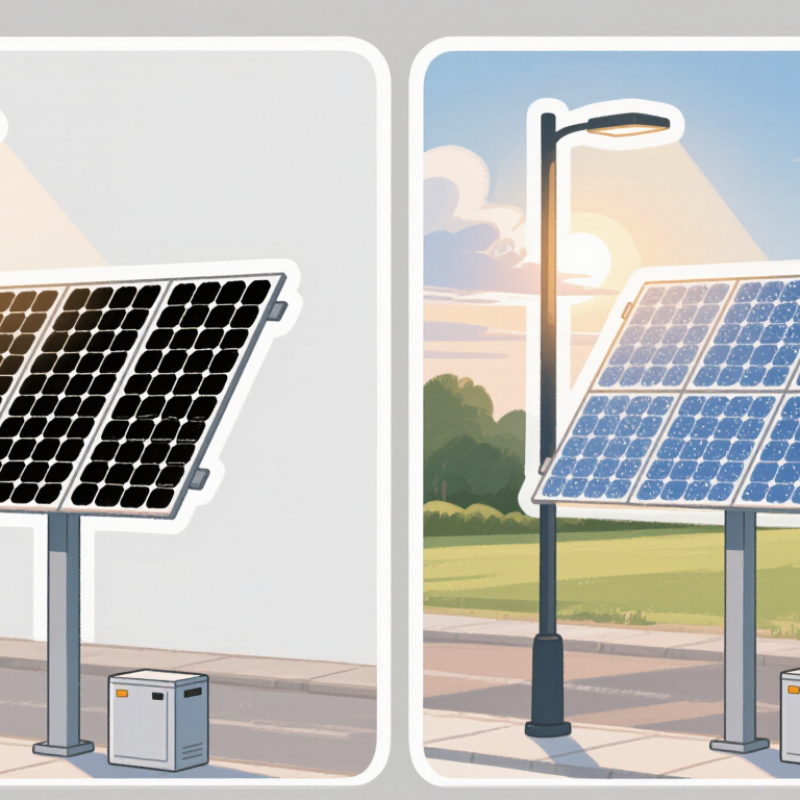
Monocrystalline panels usually provide higher power from a smaller surface. That matters when a narrow pole has limited mounting space. Polycrystalline panels can offer acceptable output, but their lower efficiency may require a larger area. Fraunhofer ISE’s Photovoltaics Report 2024 shows mainstream commercial module efficiencies commonly exceeding 20%, with monocrystalline technology leading current production.
However, efficiency alone can mislead. Heat, dust, tilt, shading, and winter sunlight often affect real output more than the label. I have seen a theoretically superior panel underperform because nearby trees blocked morning light. Field conditions deserve more attention.
Tips: Check solar irradiation, nighttime hours, battery autonomy, and LED wattage together. Allow seasonal losses. Recheck the design after installation. A small data logger can reveal cloudy-day shortages that calculations miss. Polycrystalline may still fit spacious sites, while monocrystalline usually suits compact poles and demanding winter schedules.
For solar street lights, the practical debate is rarely about appearance. It is about energy yield from a limited pole-top area. Monocrystalline panels use purer silicon and usually deliver higher efficiency. The Fraunhofer Institute’s Photovoltaics Report 2024 places leading commercial crystalline-silicon modules broadly above 20% efficiency, while polycrystalline designs generally remain lower. That difference can provide more winter charging from the same panel size.
Polycrystalline panels still have a place. They can cost less and may suit wide, low-cost lighting systems with generous mounting space. Their blue, fragmented-cell surface is not merely cosmetic. It reflects a different manufacturing process and typically lower power density. The IEA PVPS Trends report identifies crystalline silicon as the dominant photovoltaic technology worldwide, but it does not say every project needs monocrystalline modules. Site conditions decide more than market share.
Street-light performance also depends on heat, dust, shading, battery capacity, and controller settings. The National Renewable Energy Laboratory reports that photovoltaic output falls as module temperature rises. A panel beside a hot road can therefore lose more energy than its laboratory rating suggests. Monocrystalline modules often make sense where winter sunlight is weak or the pole has little space. Polycrystalline modules may work when the array is larger and replacement budgets are tight. A useful doubt remains: higher efficiency does not guarantee better lighting if the battery is undersized. Check monthly solar irradiation, not only the nameplate rating. Industry reports provide averages; one dusty site can behave differently.
Typical commercial module values show that monocrystalline panels generally provide higher efficiency and greater power output in limited mounting areas. Polycrystalline panels usually have a lower purchase cost, but their lower efficiency can require more surface area for the same street-lighting power. Temperature coefficient and annual degradation values are approximate industry ranges, so actual performance depends on cell design, climate, installation, and operating conditions.
2026 Best Solar Panels for Street Lights: Monocrystalline or Polycrystalline?
How to Choose the Right Panel for Street Light Conditions
Choosing a solar panel for a street light starts with the site, not the panel label. Monocrystalline panels usually deliver higher output in limited spaces. Polycrystalline panels can offer practical value where installation space is generous. In real projects, both types can perform well when correctly sized. A shaded panel still produces disappointing energy, regardless of its advertised efficiency.
Inspect the pole location at different hours. Nearby trees, buildings, dust, and seasonal shadows can reduce charging time. Check local sunlight levels, winter conditions, and the light’s nightly operating schedule. High temperatures may reduce panel output, while snow or dirt can block the surface. Select a panel with enough reserve for cloudy days, but avoid excessive sizing without checking the battery and controller. I have seen systems fail because the panel was capable, but the storage capacity was too small. That detail is easy to miss.
Tips: Measure shade before installation. Keep the panel angled toward the strongest sunlight. Leave access for cleaning and inspection. Compare real operating data, not only laboratory efficiency. A short field test can reveal weak charging, unexpected shadows, or poor nighttime performance. Do not assume the brightest summer day represents the whole year. Recheck the design after installation. Improvements are sometimes needed.
For 2026 street-light projects, monocrystalline panels usually suit compact poles and limited land. Their higher efficiency can produce more energy from the same mounting area. Fraunhofer ISE’s Photovoltaics Report 2024 notes that commercial crystalline-silicon modules commonly exceed 20% efficiency. Polycrystalline modules can still work well where space is available and upfront cost matters. The choice is not only about panel type.
Installation quality often decides real performance. Keep the panel clear of tree shadows, dust, and nearby buildings. A small morning shadow can reduce daily harvest more than expected. Tilt and orientation should match the local latitude and seasonal sunlight. The IEA PVPS Trends 2024 report recorded more than 440 GW of new solar capacity worldwide in 2023, but street-light systems operate differently from grid-scale arrays. Their panels face changing shade, heat, and vandalism risks. Real sites are messier.
Battery matching needs careful calculation. Size the battery for nightly lighting hours, cloudy-day autonomy, temperature, and the controller’s usable depth of discharge. Oversizing the panel without enough battery capacity wastes midday energy. Oversizing the battery without sufficient winter solar may leave it chronically undercharged. NREL’s PVWatts guidance emphasizes local weather data for energy estimates, not simple nameplate ratings. A practical design should test the darkest month, LED load, cable losses, and battery aging. I still see projects using average sunlight values. That shortcut needs rethinking. Check the first winter before scaling the design.
Solar street-light selection is shifting from simple price comparisons to energy-yield planning. Fraunhofer ISE’s Photovoltaics Report 2024 indicates that crystalline-silicon modules represent over 95% of the global market. Monocrystalline panels usually provide higher efficiency in limited spaces. That matters when a narrow lighting pole must collect winter sunlight. Polycrystalline panels can still suit larger installations with less severe area limits. Their lower purchase price may support wider deployment, but efficiency losses require careful battery sizing.
The 2026 trend is system matching. Designers now examine local irradiance, shading, panel tilt, battery chemistry, and nighttime lighting schedules together. NREL research commonly uses about 0.5% annual degradation as a practical median for crystalline-silicon modules. Over ten years, small losses become visible. A panel that looks adequate in June may undercharge a battery during cloudy December nights. That is where many specifications feel too optimistic. The International Energy Agency Photovoltaic Power Systems Programme also highlights rapid global PV expansion, increasing pressure for reliable quality control and lifecycle planning. Mono is often the safer choice, though not automatically the best one.
Tips: Request a month-by-month energy simulation, not only peak-watt ratings. Check low-light performance, temperature coefficients, and warranty degradation terms. Leave charging margin. Street lighting fails after sunset, not at noon. Polycrystalline can work well in budget-sensitive projects, but only after confirming winter autonomy and available mounting area.
Monocrystalline panels usually offer higher efficiency and power density. They suit narrow poles and limited mounting areas. Polycrystalline panels usually cost less. They need more space for similar output.
Monocrystalline panels often perform better where winter sunlight is weak. Their higher efficiency can collect more energy from the same surface. Still, local weather matters more than labels. Check the darkest month.
Yes, they can suit wide lighting systems with generous mounting space. They may reduce the initial purchase cost. However, lower power density can require larger panels. That trade-off is easy to underestimate.
No. A small battery can waste the panel’s advantage. Lighting also depends on battery capacity, controller settings, heat, dust, and shading. A highly efficient panel cannot fix poor system matching. The panel is only one piece.
Keep it clear of tree shadows, dust, and nearby buildings. Match the tilt and direction to local sunlight conditions. Even a small morning shadow can reduce daily energy collection. Clean surfaces matter.
Size the battery for nightly lighting hours and cloudy-day autonomy. Include temperature effects, cable losses, and battery aging. An oversized panel may waste midday energy. An oversized battery may stay undercharged. That mistake deserves review.
Request month-by-month energy estimates, not only peak-watt ratings. Check local solar irradiation and the lowest-sunlight period. Review temperature coefficients, low-light performance, and degradation terms. Average sunlight can mislead.
Not always. A lower-cost panel may work when space is available. A higher-efficiency panel may reduce the required mounting area. Compare lifetime energy, replacement access, and winter reliability. Cheap today may cost more later.
Solar panels for street lights convert sunlight into electricity during the day, store energy in batteries, and power LED fixtures at night. When comparing options, the key question is: what is the difference between monocrystalline and polycrystalline panels for street lights? Monocrystalline panels generally offer higher efficiency, better performance in limited space, and stronger output under weaker light, while polycrystalline panels can provide a practical and economical solution where installation space and sunlight are sufficient.
Choosing the right panel depends on local climate, daily sunlight hours, temperature, shading, available mounting area, and required lighting time. Proper installation angle, ventilation, controller settings, and battery capacity are equally important for stable performance. In 2026, panel selection is increasingly focused on higher conversion efficiency, improved low-light operation, longer service life, and better integration with intelligent lighting systems. A balanced design should consider total system performance and lifecycle value rather than panel type alone.

OneAll Lights