What is the average lifespan of an outdoor LED lamp driver? The practical answer is often 50,000 to 100,000 operating hours, but that figure requires careful interpretation. It may equal 11 to 22 years under ideal conditions, with roughly twelve hours of daily use. Real installations can perform differently.
The U.S. Department of Energy’s Solid-State Lighting reports explain that LED systems should be evaluated through useful life, lumen maintenance, and failure behavior. They also warn that an LED package and its driver do not necessarily share the same lifespan. A driver installed inside a sealed parking-lot fixture may face heat above 70°C, moisture, voltage surges, and capacitor aging. Those details matter more than a marketing label.
As James Brodrick, a former U.S. Department of Energy SSL program manager, has stated, “LEDs don’t burn out; they fade away.” That principle is valuable, though incomplete for drivers. Drivers can fail suddenly. Industry reliability guidance commonly treats 50,000 hours as a target, not a promise. Reports from the DOE and the Illuminating Engineering Society also stress that temperature, testing conditions, and maintenance influence service life.
This guide examines five practical factors: thermal design, component quality, surge protection, enclosure sealing, and operating conditions. The estimate may be imperfect. It should be.
A cool, well-sealed fixture can outlast a poorly ventilated one by years. Calculating the average lifespan of an outdoor LED lamp driver therefore requires field evidence, not only a printed number.
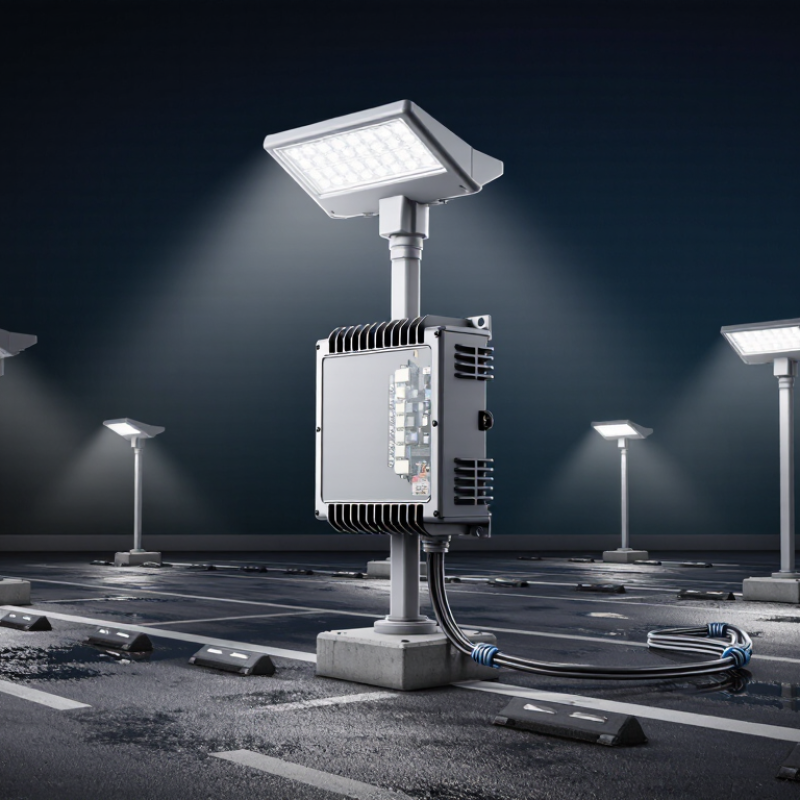
An outdoor LED driver converts incoming AC power into stable DC current for the LED module. It also manages dimming, short-circuit protection, temperature changes, and voltage surges. Without it, brightness may flicker or fail completely. Outdoor conditions make this component work harder. Rain, dust, salt air, freezing nights, and direct sunlight can accelerate aging. Heat remains the quietest threat. Field inspections often find damaged capacitors, cracked seals, or corrosion before the LED chips fail.
The U.S. Department of Energy’s LED Luminaire Lifetime report explains that a 50,000-hour rating often describes lumen maintenance, not guaranteed driver survival. At twelve hours each night, 50,000 hours equals about 11.4 years. That estimate can shrink quickly when the driver’s case temperature stays high. Industry reliability guidance commonly applies the ten-degree rule: lowering capacitor temperature by 10°C can approximately double its expected life, depending on design and materials. Real performance varies.
Look at the driver’s temperature rating, surge protection, enclosure rating, and capacitor quality. ENERGY STAR specifications also emphasize tested lifetime and environmental performance for qualifying LED products. Those tests are useful, but installation still matters. A sealed housing with poor heat dissipation can defeat a good design. That is an uncomfortable detail. A longer warranty does not automatically mean a longer outdoor life. Regular checks for flicker, delayed startup, moisture, and unusual heat can reveal problems before nighttime lighting disappears.
Outdoor LED drivers typically last five to ten years in real installations. Well-cooled units may operate longer, while hot, wet locations shorten that period. Laboratory ratings can suggest 50,000 hours or more, but field conditions matter more. That estimate can mislead. An enclosure mounted above a dark roof may absorb intense afternoon heat. Every extra degree stresses capacitors and speeds aging.
Moisture creates another problem. Condensation, failed seals, and repeated temperature changes can corrode terminals or circuit boards. Power quality also matters. Frequent surges, unstable voltage, and undersized wiring may cause early failure. During service inspections, I have found heat damage before visible flickering begins. Discolored terminals and brittle insulation deserve immediate attention.
To estimate service life accurately, check the driver’s rated case temperature, ingress protection rating, load range, and installation position. Measure operating temperature during the hottest part of the day, not on a mild morning. Keep airflow clear, use sealed connections, and avoid running the driver continuously at maximum load. Surge protection can help in exposed locations. Still, maintenance records are often incomplete, making predictions less certain. Replace a driver when output becomes unstable, protection trips repeatedly, or corrosion spreads. Record the date, temperature, and symptoms after every inspection.
5 Tips: What Is the Average Life of Outdoor LED Drivers?
Which Environmental Factors Affect Outdoor LED Driver Life?
Outdoor LED drivers commonly last 50,000 to 100,000 hours under controlled conditions. Real installations often achieve less. Heat is usually the main concern. A sealed enclosure can trap warmth around the driver, especially beneath dark roofing or inside compact signs. Every extra degree can accelerate capacitor aging and reduce electrical stability.
Moisture creates another serious risk. Condensation may form when a cold driver warms quickly after sunrise. Rainwater can also enter through damaged seals, loose cable glands, or poorly positioned covers. Salt air is harsher near coastlines. It attacks terminals and metal surfaces slowly, sometimes invisibly. Dust and insects can block ventilation paths, while chemical vapors near factories may weaken protective coatings.
Voltage quality matters too. Frequent surges, unstable supply, and incorrect wiring place stress on internal components. Vibration from traffic, fans, or nearby machinery can loosen connections over time. UV exposure may crack plastic housings and cable insulation. During field inspections, I have seen a driver fail early because its enclosure faced direct afternoon sun. The installation looked acceptable. It was not.
Choose a driver with suitable ingress protection, thermal clearance, and surge protection. Keep drainage paths open. Inspect seals, terminals, and mounting surfaces during routine maintenance. Do not assume “outdoor-rated” means maintenance-free. That assumption causes avoidable failures. Even careful designs need review after one harsh season.
Practical reference data for evaluating outdoor LED driver service life and environmental exposure
| Data Dimension | Typical Outdoor LED Driver Data | Primary Effect on Life | Recommended Practice |
|---|---|---|---|
| Average service life | Approximately 50,000–100,000 operating hours for well-designed outdoor drivers under rated conditions | Represents roughly 5.7–11.4 years of continuous operation, or about 11–23 years at 12 hours per day | Use the manufacturer's published lifetime curve and verify the stated case temperature, load, and ambient conditions |
| Electrolytic capacitor life | Often the main life-limiting component; many rated designs specify approximately 5,000–10,000 hours at 105°C for the capacitor itself | High internal temperature accelerates electrolyte evaporation and reduces capacitance | Choose high-temperature components, keep the driver cool, and avoid installing it inside poorly ventilated enclosures |
| Ambient temperature | Common outdoor operating ranges are approximately −20°C to +50°C, depending on the design | Higher ambient temperature raises internal component temperature; a common engineering rule is that each 10°C reduction can approximately double electronic component life | Provide thermal clearance, avoid direct heat sources, and check the maximum case-temperature limit |
| Humidity and condensation | High humidity, dew, and condensation are common risks in exterior installations | Moisture can cause corrosion, insulation deterioration, leakage current, and intermittent faults | Use sealed cable entries, suitable gaskets, breathable pressure-equalizing vents where appropriate, and prevent water pooling |
| Ingress protection | Outdoor housings commonly use IP65 or higher; IP ratings must match the actual exposure and installation position | Insufficient protection allows dust or water ingress, increasing short-circuit and corrosion risk | Select an enclosure rating appropriate for rain, dust, washdown, and temporary water exposure; install cable glands correctly |
| Rain, snow, and ice | Repeated wetting, freezing, and thawing can occur in exposed locations | Thermal cycling and trapped moisture may damage seals, solder joints, and protective coatings | Mount the driver in a protected orientation, provide drainage, and use materials rated for freeze–thaw exposure |
| Salt spray and corrosive atmosphere | Coastal and industrial areas may expose equipment to salt, sulfur compounds, or chemical pollutants | Corrosion can affect terminals, circuit-board tracks, heat sinks, and enclosure fasteners | Use corrosion-resistant hardware, conformal coating where suitable, and periodic inspection and cleaning |
| Electrical surges and lightning | Outdoor power lines can experience switching transients and lightning-related surges | Repeated or severe surges can damage input protection, switching devices, and control circuits | Use coordinated surge protection, proper grounding, short protective connections, and installation-compliant wiring |
| Load level | Operation near the maximum rated output produces more heat than operation at a moderate load | Higher load increases stress on switching components, capacitors, magnetics, and thermal interfaces | Allow reasonable capacity margin and confirm the driver is not continuously overloaded or poorly ventilated |
| Thermal cycling | Daily heating and cooling may occur as outdoor lighting switches on and off | Repeated expansion and contraction can fatigue solder joints, connectors, and component interfaces | Use robust mechanical construction, minimize abrupt temperature changes, and avoid mounting near hot surfaces |
| Maintenance and inspection | Visual and electrical checks every 6–12 months are often practical for critical outdoor lighting | Early detection of corrosion, loose terminals, blocked ventilation, or water ingress can prevent secondary damage | Inspect seals, cables, mounting points, surge protection, temperature, and abnormal noise or flicker |
An outdoor LED driver often lasts five to ten years, but conditions matter more than the calendar. Heat is a major concern. Install the driver in a shaded, ventilated location, leaving clear space around its housing. A dusty enclosure can trap heat, even when the air feels cool. Measure the case temperature during summer operation. Guessing is not enough.
Keep the driver below its maximum rated load. Running at 70–80% capacity usually reduces thermal stress and capacitor aging. Avoid frequent switching when the lighting system does not require it.
Add suitable surge protection and verify grounding during installation. Lightning and unstable utility power can damage components within seconds. This step is sometimes skipped.
Moisture control needs equal attention. Use correctly rated connectors, tighten cable glands, and prevent water from pooling near the enclosure. Inspect seals after severe weather.
Clean dirt from vents and check for corrosion twice yearly. Look for swollen capacitors, darkened terminals, unusual noise, or flickering lights. Replace damaged parts early.
One practical lesson is easy to miss: a driver may still operate while already losing efficiency. Record temperatures, load conditions, and inspection dates. These notes improve maintenance decisions, although field measurements are not always perfect.
5 Tips: What Is the Average Life of Outdoor LED Drivers?
Outdoor LED drivers commonly last five to ten years, but harsh conditions can shorten that period. Heat, moisture, voltage surges, and heavy loading are frequent causes of early failure. The driver’s temperature matters greatly. A hot metal enclosure near direct sunlight may age much faster than a shaded, ventilated unit.
Watch for flickering, delayed start-up, sudden dimming, buzzing, or lights that switch off after warming. These symptoms often indicate overheating, unstable output, or failing internal components. Inspect cable glands, seals, and terminals for cracks, water marks, rust, or loose connections. A basic voltage test can reveal problems that are not visible.
Prevention starts with correct sizing. Choose a driver with enough power reserve, rather than operating it continuously at full capacity. Keep drainage paths clear, and mount the enclosure above standing water. Clean dust from ventilation areas, but avoid forcing water into seals. Surge protection is valuable where storms or unstable supply lines are common. I have seen outdoor systems fail because one small cable entry was left unsealed. It looked harmless. It was not.
Record installation dates, operating temperatures, and repeated faults. Replace damaged seals promptly, even when the lights still work. Maintenance schedules can be imperfect, especially on remote sites, so simple inspection notes are better than relying on memory.
Estimated driver life decreases as case temperature rises. The model uses a common electrolytic-capacitor rule: service life approximately halves for every 10°C increase above the reference temperature.
Reference model: 50,000 hours at 75°C case temperature. Actual life depends on load, surge protection, humidity, ventilation, component quality, and installation conditions.
It converts incoming AC power into stable DC current for an LED module. It also supports dimming, surge protection, and temperature control. Without it, lights may flicker or stop working.
A failed driver can darken an otherwise healthy LED module. It may also cause delayed startup, unstable brightness, or repeated protection trips. Longer rated life does not guarantee longer field performance.
Real installations commonly provide five to ten years of service. Controlled tests may suggest 50,000 to 100,000 hours. Those figures can mislead. Heat, moisture, and poor power quality often shorten actual life.
High heat, condensation, rain, salt air, dust, insects, vibration, and ultraviolet exposure can accelerate aging. A dark enclosure under afternoon sunlight may become surprisingly hot. Coastal air can slowly corrode terminals.
Heat stresses capacitors and can reduce electrical stability. Lowering capacitor temperature by 10°C may approximately double expected life. Results vary with design and materials. Measure temperatures during the hottest afternoon.
No. A sealed housing can still trap heat and condensation. Damaged seals, loose cable glands, and blocked drainage may allow moisture inside. “Outdoor-rated” does not mean maintenance-free.
Check flickering, delayed startup, unusual heat, moisture, corrosion, and discolored terminals. Inspect seals, cable insulation, mounting surfaces, and airflow paths. Record the date, temperature, and observed symptoms.
Replace it when output becomes unstable or protection trips repeatedly. Widespread corrosion, cracked seals, brittle insulation, or heat damage also require attention. Waiting for total darkness is not ideal.
An outdoor LED driver regulates the power supplied to an LED lamp, helping maintain stable brightness, efficiency, and safe operation. Understanding what is the average lifespan of an outdoor led lamp driver is important because driver failure can reduce lighting performance, increase maintenance costs, and cause unexpected outages. In typical outdoor conditions, a well-designed and properly installed driver may operate for many years, although its actual service life depends on temperature, moisture, voltage stability, dust, vibration, and workload.
To extend service life, choose a driver with suitable power capacity, provide adequate ventilation, protect it from water and condensation, and keep electrical connections clean and secure. Regular inspections can reveal warning signs such as flickering, delayed start-up, unusual noise, overheating, or inconsistent brightness. Addressing these symptoms early, removing dirt, checking seals, and ensuring stable voltage can help prevent sudden failure. With suitable protection and routine maintenance, outdoor LED drivers can deliver reliable performance for a longer period.

OneAll Lights